You might think the Federal Government’s proposed tax on family trusts has nothing to do with you. You don’t have a trust. Perhaps you have an SMSF, a regular super fund, or you’re simply working hard to pay your bills and build some savings.
But there’s a much bigger issue here, and it’s one that should concern every Australian. Does the Government really understand what its policies cost, and how much confidence can we have in the numbers we’re being given?
Small-business owners are fighting back
A growing movement of small-business owners and their accountants is challenging the Federal Government’s proposed 30% minimum tax on discretionary trust distributions, scheduled to commence on 1 July 2028. Last week, they took their concerns directly to Canberra.
For family businesses operating through trusts, the issue isn’t just additional tax. It’s the potentially enormous cost of restructuring businesses they’ve spent years building. We’re talking about accounting and legal fees, transferring assets, stamp duty and ongoing compliance expenses. None of this comes cheap.
And here’s where the numbers get interesting.
Treasury estimates the reforms’ one-off implementation costs at $780 million to $1.1 billion. CPA Australia, however, estimates professional assistance alone could cost affected trusts $2 billion to $2.8 billion, before other restructuring expenses.
The estimates use different assumptions, but that’s still an enormous gap. The Government says the reforms will improve tax fairness and has proposed measures to reduce disruption. Small-business owners and their accountants are asking whether those measures go far enough, and whether the Government really understands what families could be facing.
Surely that’s something worth getting right before asking people to make potentially expensive and irreversible decisions?
Why this matters to YOU
You might not own a business or have a family trust, but chances are you have superannuation. Perhaps you’ve established an SMSF, own an investment property or are simply trying to put enough aside for a comfortable retirement.
So here’s the bigger question. If Treasury’s estimates of the cost of restructuring small businesses are being challenged by billions of dollars, how confident can we be that future changes affecting our superannuation, savings or investments will be properly assessed?
That doesn’t mean your superannuation is next. But governments regularly review taxes and concessions, and when the rules change, it’s ordinary Australians who have to adjust their plans and finances.
Nearly $930,000 a year, but a misunderstanding about cash flow?
Meanwhile, another interesting revelation emerged at Senate Estimates. ATO Commissioner Rob Heferen acknowledged that he’d wrongly assumed businesses using credit cards to manage cash flow were financially struggling.
Really? Anyone who’s run a business knows that using credit facilities to manage the timing of expenses and incoming payments is perfectly ordinary. It doesn’t automatically mean you’re in financial trouble.
Yet the ATO had proposed removing direct credit card payments for tax liabilities, a change affecting hundreds of thousands of small businesses. Following considerable criticism, the arrangements have been extended until 30 June 2027.
The ATO cited substantial processing costs, which is a legitimate consideration. But surely understanding how businesses actually operate should be part of the decision-making process in the first place?
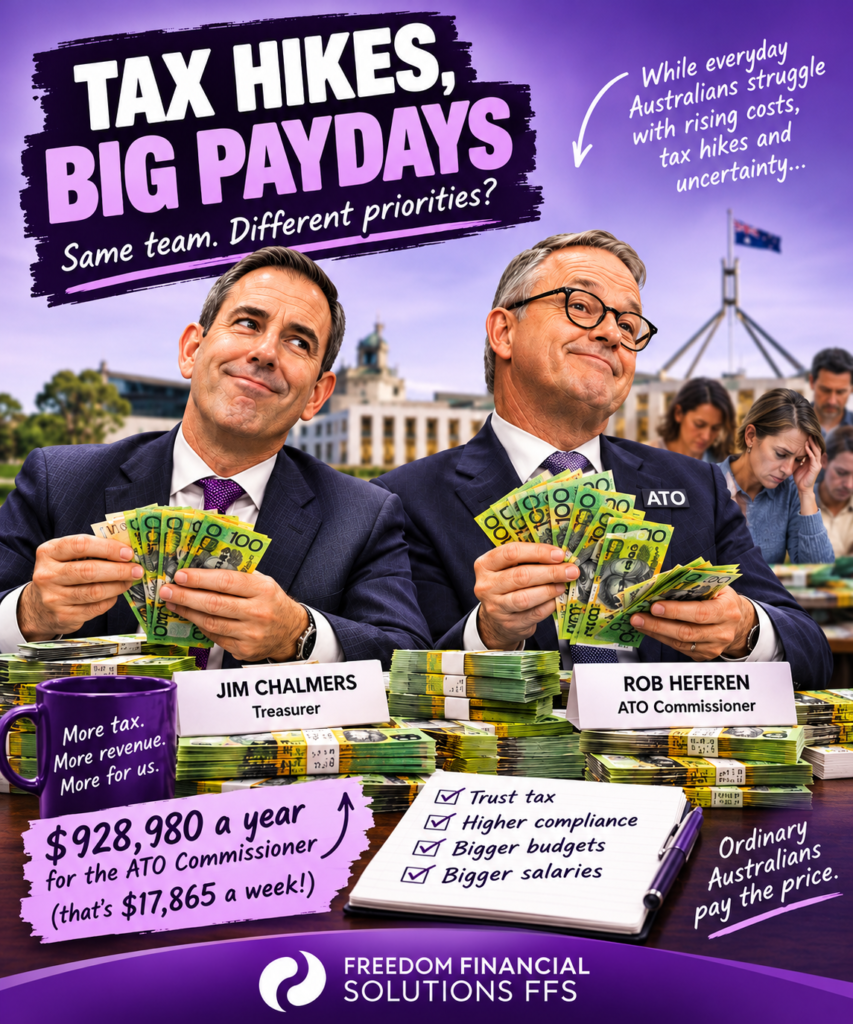
And to rub salt into the wounds of Australians struggling with rising costs, Heferen was also asked at Senate Estimates about his remuneration. He confirmed an annual package of $928,980, including superannuation. That’s a whopping $17,865 a week!
And who’s balancing Canberra’s budget?
According to the Department of Finance, Commonwealth net debt stood at $552.8 billion at 30 September 2026. In just the first three months of the 2026-27 financial year, the Federal Government also recorded a $14.5 billion underlying cash deficit, although that was better than the Budget forecast for the period.
Now, government finances are obviously more complicated than a household budget, and debt and deficits have many causes. But when you’re dealing with figures of this magnitude, surely getting the numbers right matters more than ever.
Small-business owners and everyday Australians have to manage their expenses, pay their bills and make difficult decisions when money is tight. If they get their calculations wrong, they’re the ones who wear the consequences.
Governments face financial pressures too, and when they need additional revenue, taxes and concessions are among the things they can change. That’s why we should all be paying attention to how those decisions are made, whether the costings stack up and who ultimately pays.
Because the next tax debate might involve something you own, something you’ve saved or something you’re relying on for retirement.
Trust has to be earned
The growing Stop the Ambition Tax movement is calling for genuine small businesses with aggregated annual turnover below $10 million to be exempt from the proposed trust tax.
The Government maintains that more than 90% of active small businesses will not be affected in any given year. But small-business owners and their accountants want the real costs properly understood before the changes become law, and that’s a reasonable question to put to policymakers.
Australians are expected to navigate an extraordinarily complicated tax system, meet their obligations and face penalties when they get things wrong. Surely it’s fair to expect the people designing and administering that system to be equally accountable for their numbers.
Whether you own a business, run an SMSF or simply work hard and save for your future, this matters to you.
Because when governments change the rules, it’s Australians who have to live with the consequences.
Learn more about the campaign at Stop the Ambition Tax.
General information only. Not personal financial advice or taxation advice.