There’s a lot of uncertainty in markets right now.
Property investors are nervous as Sydney property prices appear to be taking a plunge. Stock markets are becoming more volatile. Inflation remains sticky. Interest rates are still biting. And many Australians are starting to ask a bigger question about where they actually want to store wealth over the next decade.
For many FFS readers, that conversation usually comes back to three tangible asset classes: property, gold and silver.
And right now, silver is attracting serious attention.
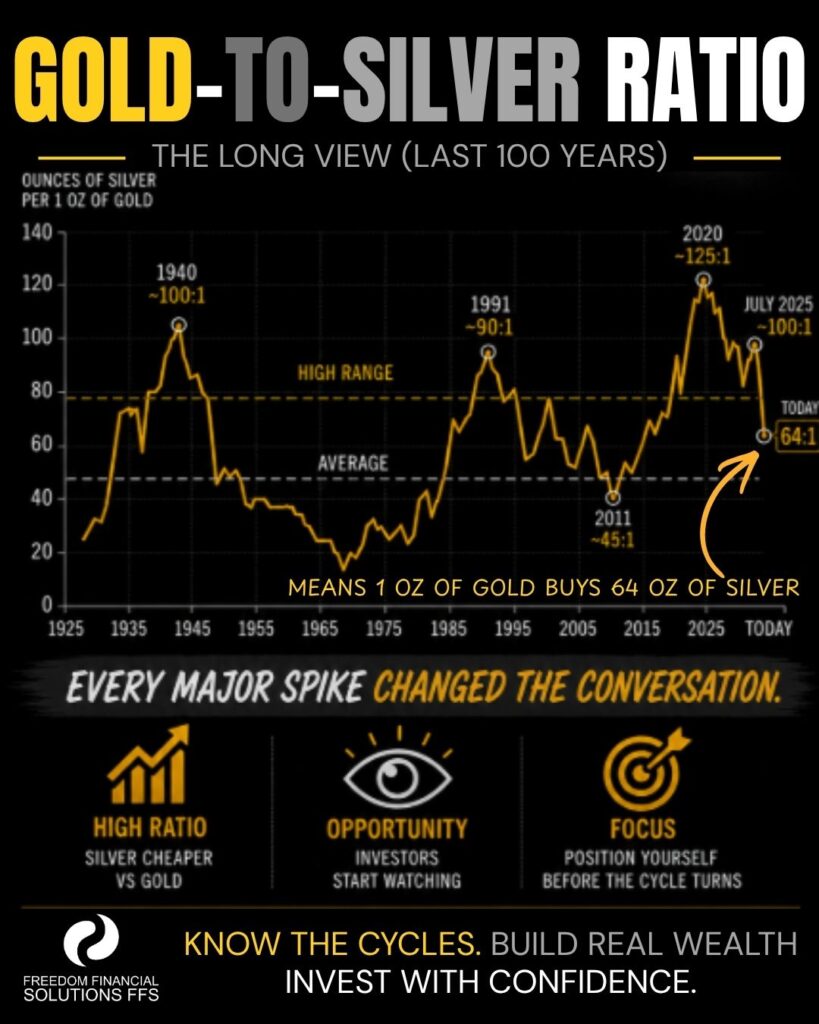
A recent discussion from Ainslie Bullion focused heavily on what they see as a major long-term opportunity developing in silver, particularly when viewed through the Gold-to-Silver Ratio (GSR).
The GSR simply measures how many ounces of silver it takes to buy one ounce of gold. Historically, when that ratio is high, silver has often been considered relatively undervalued compared to gold.
According to Ainslie, the ratio remaining above 50 is still supportive for silver buyers. Their broader view is that silver may still be early in a much larger long-term cycle.
Gold and silver, however, play very different roles in a portfolio.
Gold is generally viewed as financial insurance. Investors hold it as protection against inflation, currency debasement and broader financial instability. It tends to behave more defensively during periods of economic stress.
Silver is different. It is far more volatile and tends to move aggressively during precious metals bull markets. That volatility is exactly why some investors become interested in silver during certain phases of the economic cycle. The trade-off, of course, is that silver can also experience much larger swings along the way.
One of the more interesting parts of the discussion was the comparison between precious metals and property.
For decades, Australians have viewed property as the ultimate safe investment. But many investors are now starting to feel trapped by the lack of flexibility that comes with highly leveraged property portfolios.
Higher interest rates, rising holding costs, tax uncertainty and softer market conditions are all creating pressure in parts of the property market. That doesn’t mean property suddenly becomes a bad asset.
But it does highlight a major difference between property and precious metals: liquidity.
Gold and silver can be bought gradually, sold quickly and adjusted more easily as market conditions change. Property simply doesn’t offer that same flexibility. If market conditions deteriorate and many investors try to sell at once, property markets can become very slow-moving.
That flexibility is one of the reasons many investors continue allocating part of their wealth to physical metals.
Ainslie’s broader argument is not necessarily that property collapses or becomes irrelevant. Their view is more about where we currently sit in the economic cycle, and how different assets may behave over the coming years.
Their expectation is that gold remains strong as a long-term hedge, while silver may still have significant upside during this phase of the cycle. At the same time, they expect property and broader stock markets to become increasingly volatile.
Importantly, even they acknowledge nobody can predict exact prices or exact timing. Cycles may help frame probabilities, but markets rarely move in perfectly predictable ways. For long-term investors, the bigger takeaway may simply be this:
Different assets serve different purposes.
- Property can provide leverage and long-term growth.
- Gold can provide stability and wealth preservation.
- Silver can provide volatility and potentially larger upside during strong commodity cycles.
The key is understanding what role each asset plays in a portfolio — and making sure you are not relying entirely on one asset class in an increasingly uncertain world.
The take away
At FFS, we believe the “self” part of an SMSF is about education, understanding and taking ownership of your investment decisions.
The more you learn about how different asset classes behave through changing market cycles, the more confidently you can position yourself to protect and grow your wealth over the long term.
Whether it’s property, gold, silver or shares, informed investors are generally better equipped to navigate uncertainty than those reacting emotionally to headlines.
That’s why FFS exists — to empower Australians through financial education, strategic thinking and deeper investment understanding so they can take greater control of their financial future.