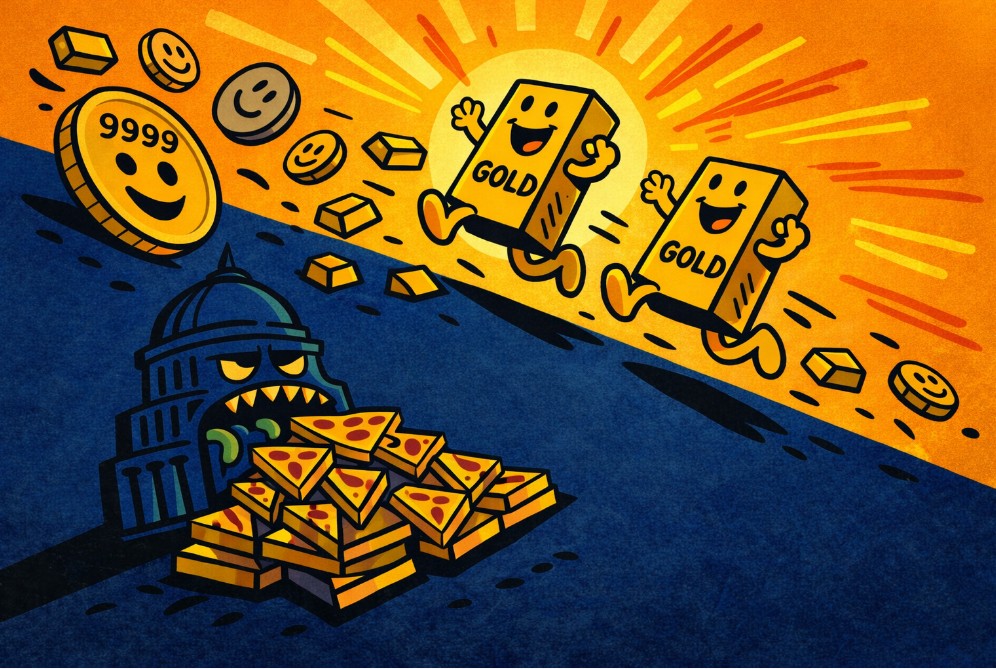
What’s the connection between pizza, power and gold? More than you could imagine.
History shows that power tends to operate behind closed doors. Major decisions are rarely announced in advance. Markets often move before the public understands why. Whether in finance, geopolitics or institutional behaviour, the signals usually appear quietly first.
One of the more unusual signals that observers have tracked over the years is the so-called “Pentagon Pizza Index.”
The idea traces back to the 1980s, when a Domino’s franchise owner operating near Washington DC’s government buildings noticed a pattern. Late-night pizza orders surged just before major military actions. Orders reportedly spiked prior to the invasion of Grenada in 1983, again before Panama in 1989, and during the Gulf crisis in 1990. The pizza itself was irrelevant. The overtime activity inside government buildings was not.
The concept is straightforward. When senior officials and defence staff are working unusually late in Washington, nearby restaurants — particularly pizza outlets — often see a noticeable spike in activity. Over time, observers have pointed out that elevated late-night food orders have sometimes coincided with significant geopolitical developments.
It is not an official metric. It is not a predictive model. It is simply an observable pattern.
But patterns around power are rarely meaningless.
What It Is Showing Currently
Recent monitoring of restaurant traffic near major US government buildings has again shown elevated late-night activity. These increases have occurred alongside heightened geopolitical tension and shifting global alignments.
This does not confirm that any specific event is imminent. However, it reinforces a broader reality: when decision-makers are working overtime, something is being assessed. Markets may not know the details yet, but they eventually respond to the outcomes.
Power rarely signals its intentions publicly. But activity leaves traces.
Why This Matters for Gold
Gold has historically responded to uncertainty, instability and institutional stress.
When geopolitical tension rises, capital often seeks protection. When confidence in systems weakens, investors look for assets outside those systems. Gold has served that role across wars, monetary resets and sovereign debt crises.
It is not about pizza. It is about opacity and consequence.
When concentrated power operates quietly, markets reassess risk. When risk rises, defensive assets tend to strengthen. That relationship has repeated for centuries.
Central banks continue accumulating gold. Sovereign debt levels remain historically elevated. Global power dynamics are shifting. These are structural realities, not short-term headlines.
The Pizza Index, quirky as it may be, is simply another reminder that important decisions are often made long before the public narrative catches up.
For investors who understand that power and money are deeply intertwined, the message is straightforward.
When the Pentagon orders pizza, investors take note.