Many people have noticed that the price of silver has been rising very quickly and are asking why this is happening now, after years of relative calm. The short answer is that silver is responding to stress building beneath the surface of the financial system, and historically, it is one of the first places where that stress becomes visible.
Silver is unusual because it sits in two worlds at once. It is a real, physical metal used every day in industry, particularly in electronics, medical equipment and renewable energy. At the same time, it is heavily traded through financial contracts such as futures, options and other derivatives. In fact, most silver trading today involves paper promises linked to the price of silver, rather than physical metal changing hands.
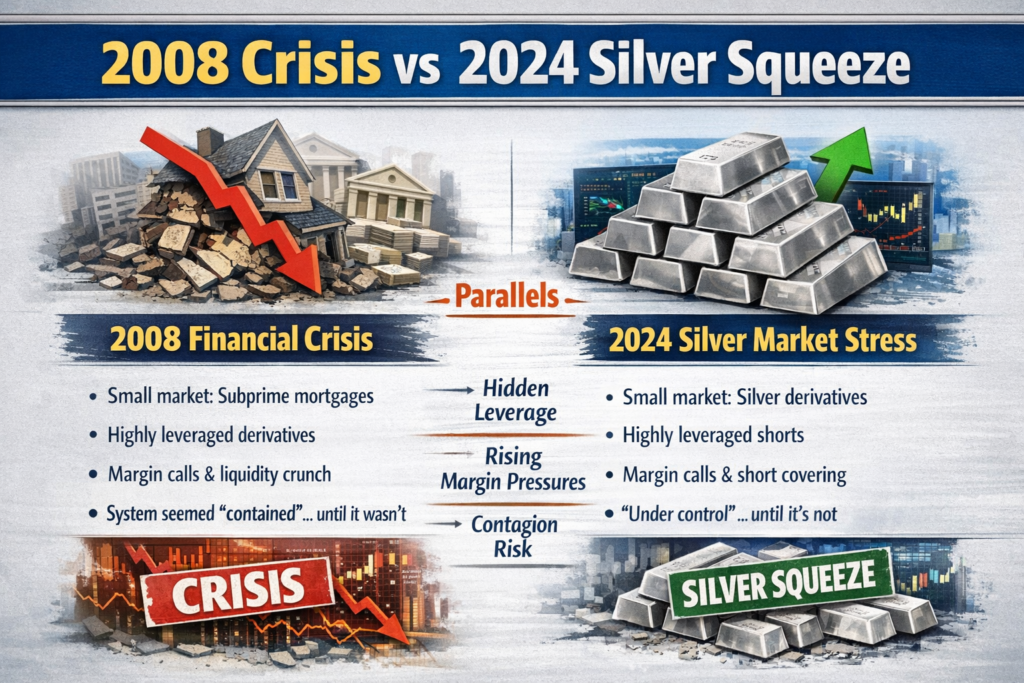
For many years, large financial institutions structured these contracts on the assumption that silver would remain within a fairly stable price range. As long as the price stayed below certain levels, the system worked smoothly and quietly in the background. However, once silver moved above those long-standing price levels, the mathematics behind many of these contracts began to fail.
When that happens, institutions are required to put up more cash as security, and some are forced to buy silver in order to close out losing positions. That buying activity pushes the price higher again, which then forces more contracts to be closed. This creates a feedback loop where prices rise faster than expected, not because of emotion or speculation, but because the structure of the system demands it.
This pattern is not new. Before the Global Financial Crisis in 2008, early stress appeared in parts of the system that most people were not paying attention to at the time. It was not housing itself that first signalled trouble, but the complex financial products built on top of it. Initially, problems were described as “contained”. Then margin requirements increased, liquidity dried up, and eventually something seemingly unrelated broke, triggering a much broader crisis.
Silver often plays this same early-warning role. Because it is a relatively small market, heavily leveraged, and backed by limited physical supply, pressure shows up there sooner than in larger markets like bonds or currencies. When confidence in paper promises weakens, people begin to prefer real assets, and silver reacts quickly.
This does not mean that a financial collapse is imminent, nor does it mean that silver prices will only move in one direction. What it does suggest is that volatility is increasing and that risk is being quietly repriced across the system. These shifts almost always begin long before they are widely discussed or acknowledged.
For everyday families, this matters because financial stress tends to surface later in very practical ways. It can show up as tighter lending conditions, sudden rule changes, higher inflation, or pressure within banking, superannuation and pension systems. Understanding the early signals allows people time to think carefully and plan sensibly, rather than being forced to react under pressure.
Silver is often described as the “canary in the coal mine” because it responds first when conditions change. At the moment, it appears to be telling us that something beneath the surface is under strain.
At Freedom Financial Solutions, our role is not to predict crises or create fear. Our role is to help clients understand risk, protect what they have worked hard to build, and remain steady when systems become less stable. Staying informed, calm and proactive has always been the most effective approach.
Warm regards,
Cass Smith
Freedom Financial Solutions
This newsletter is general information only and does not constitute personal financial advice.