2025 has been a defining year for Australian superannuation. Cyberattacks, court actions, fund collapses, unlisted asset failures and new policy proposals have exposed vulnerabilities that many members never see. When combined with historically low member engagement and opaque reporting, it raises a simple question: who is really watching your money?
2025: The Perfect Storm for Industry Super
Since the Australian Super Summit held in Washington and New York in February 2025, the industry has faced a relentless sequence of problems affecting governance, investment decisions and basic administration.
Cyberattacks on Super Funds
In March and April 2025, a coordinated cyberattack targeted several major Australian superannuation funds. Confirmed affected funds included:
Examples of the impacts include:
ASIC’s Enforcement Blitz
ASIC has launched a string of cases against major industry funds and superannuation trustees for governance failures, misleading disclosures and inadequate oversight.
One of the most significant actions relates to the collapse of the First Guardian Master Fund and Shield Master Fund. Key details include:
Other high-profile cases across 2024–2025 have involved Active Super, REST, Mercer, CBUS, Stateside and AustralianSuper, with penalties commonly in the $10–30 million range per fund.
Fund Collapses and Forced Consolidations
The First Guardian and Shield collapses are among the largest super-related failures in recent memory, with funds frozen in early 2025.
Additionally, other smaller fund managers and related investment vehicles wound up during the year. For example, Australian Fiduciaries Limited (AFL) collapsed after managing around $160 million on behalf of approximately 600 SMSFs.
These collapses highlight the fragility of opaque investment structures and the ongoing risk to members when trustees outsource functions without adequate oversight.
The $3 Million Tax and What Comes Next
The proposed tax on super balances above $3 million has been deferred, but new tax strategies are emerging. Political appetite for reshaping superannuation tax settings remains strong, and the $3 million proposal is only one example in a broader landscape of retirement savings reform.
Australia–US Investment Push
Following meetings between Prime Minister Albanese and President Trump, the government is encouraging Australian superannuation funds to increase investment in US companies, infrastructure and technology.
This shift reflects geopolitical priorities rather than member-directed investment choices and introduces additional international risk into member portfolios.
Unlisted Asset Failures: The Pine Gate Collapse
Major funds such as HESTA and QIC were heavily exposed to the billion-dollar collapse of US solar operator Pine Gate Renewables.
These exposures stem from complex unlisted and offshore investment structures that are difficult for members to understand and monitor.
Member Account Errors
A persistent issue across industry funds is administrative inaccuracy. Reviews across the sector have uncovered:
-
Misallocated contributions
-
Incorrect balances
-
Duplicate accounts
-
Insurance miscalculations
-
Unexplained fee discrepancies
-
Incomplete or incorrect reporting
Your own experience discovering errors in your account is not unusual. Most members will never know something is wrong because transparency is structurally limited.
CSLR: Another Emerging Cost for Members
The government is considering forcing superannuation schemes to contribute to the Compensation Scheme of Last Resort (CSLR) levy, largely in response to collapses such as Shield and First Guardian. Estimated CSLR levy amounts:
- 2024: $4.8 million
-
2025: $24.1 million
-
2026: $75.698 million
-
2027: $137.5 million
These costs are ultimately passed back to members through lower returns or higher fees.
The Member Blind Spot: Nobody Reads the Emails
During a complaint process with Vision Super, the Head of Communications confirmed that fewer than 30 per cent of members open emails from their super fund. This means many members will never see critical updates such as:
For example, many members were unaware of Active Super’s $10.5 million court penalty and the mandatory notice issued as part of the ruling.
A Difficult Year for Anyone in a Big Super Fund
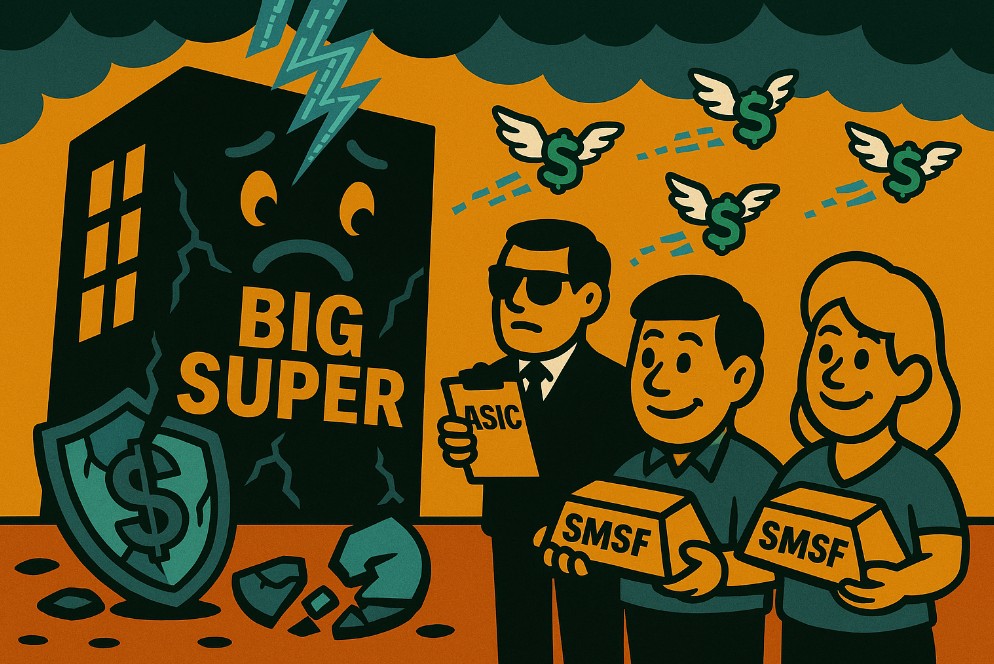
When viewed together—cyber breaches, regulatory actions, fund collapses, unlisted asset failures, account errors and new levy or tax risks—2025 has been one of the most turbulent years for Big Super in decades.
If you rely on a large industry fund without oversight or transparency, the risk profile of your retirement savings has increased significantly.
For Australians who want control, visibility and direct accountability, self-managed super funds (SMSFs) continue to offer the highest level of transparency and autonomy.
At Freedom Financial Solutions, we can help you understand your options and determine whether an SMSF is right for you.