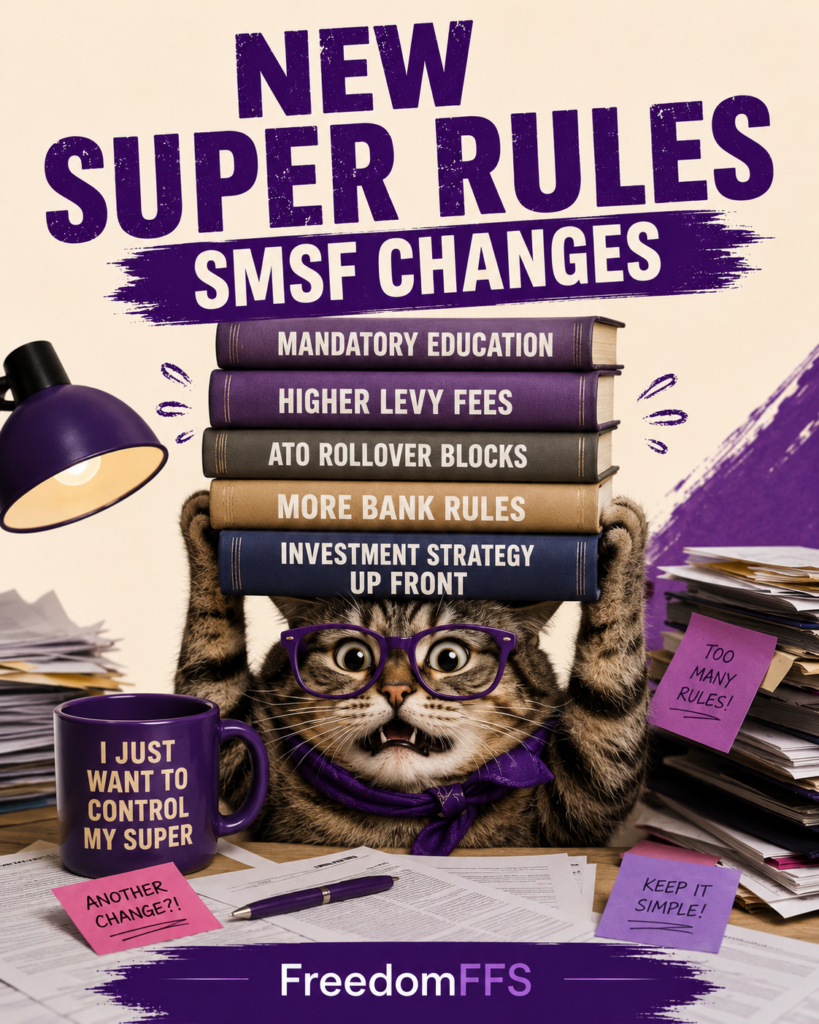
Just when you thought there had been enough change in superannuation for one year, another significant reform package has landed.
On 19 August 2026, the Australian Government announced a new package of reforms aimed at strengthening consumer protection across the superannuation and financial services system. The changes follow the collapse of the Shield and First Guardian Master Funds, which affected almost 12,000 Australians and involved around $1 billion in retirement savings.
There is a lot in the announcement, but for anyone who has an SMSF, or is thinking about establishing one, there are some particularly important changes worth understanding.
What’s changing for SMSFs?
The Government has announced a number of measures specifically aimed at the SMSF sector.
1. Mandatory education before establishing an SMSF
One of the biggest proposed changes is the introduction of mandatory trustee education before an SMSF can be registered.
The detail is still to come, but the intention is clear: before taking control of their own super, prospective trustees will be expected to demonstrate a basic understanding of the responsibilities that come with running an SMSF.
In principle, making sure people understand what they are signing up for makes sense. An SMSF gives trustees considerable control, but that control comes with legal, tax, reporting and compliance obligations.
The important question will be how the education requirement is designed.
There is a big difference between ensuring people understand their responsibilities and creating unnecessary barriers for Australians who have made an informed decision to take greater control of their retirement savings.
That balance will be worth watching.
2. The ATO could stop some rollovers into new SMSFs
Another significant proposal would give the ATO greater power to prevent a rollover into a new SMSF where it is investigating concerns involving fraud, financial abuse, misconduct or potential harm.
This measure is clearly aimed at situations where people may have been pressured or misled into moving their super.
That is very different from an ordinary Australian deciding, after doing their homework, that an SMSF is right for them.
The Government has previously acknowledged the need to balance stronger consumer protection with the right of individuals to exercise choice in the superannuation system.
That distinction matters.
3. SMSFs will need uniquely identifiable bank accounts
The Government also proposes requiring SMSFs to maintain uniquely identifiable bank accounts.
The stated purpose is to help reduce fraud risks and improve the ability of regulators to identify suspicious activity.
For legitimate SMSF trustees, this is unlikely to change the fundamental principle that fund money must be kept separate from personal money. However, the practical requirements will become clearer as the reforms progress.
4. Investment strategies are getting more attention
SMSF investment strategies are also firmly in the spotlight.
Under the announced reforms, SMSFs would be required to have a written investment strategy upfront, with further consultation proposed on ways to improve the quality and usefulness of SMSF investment strategies.
An investment strategy should never simply be a document created because there needs to be something sitting in the file for the auditor.
It is an important part of running an SMSF and should reflect the fund’s circumstances and approach to investing.
Again, the detail of the proposed changes will matter.
5. The SMSF supervisory levy is increasing
The annual SMSF supervisory levy is proposed to increase from $259 to $295, its first increase since 2013.
The Government says the additional funding will support stronger consumer protection measures and allow the ATO to engage more effectively with new trustees and identify emerging risks.
The Government also proposes aligning the levy with the establishment of the SMSF, rather than simply dealing with it through the existing arrangements.
It is not an enormous increase by itself, but it is another cost SMSF trustees need to be aware of.
6. More comparison between SMSFs and large super funds
Another interesting proposal is to give SMSF trustees, particularly those with lower balances, greater visibility of how their fund’s returns compare with members of APRA-regulated super funds.
Comparisons can be useful, but they also need context.
People establish SMSFs for many different reasons. Investment performance and costs obviously matter, but an SMSF can also be about investment choice, control, retirement planning, family circumstances and the ability to hold investments that may not be available through a conventional super fund.
A simple percentage comparison will not necessarily tell the whole story.
Why is the Government doing this?
The reforms follow some very serious failures within Australia’s superannuation and investment system.
The Shield and First Guardian collapses exposed situations where consumers were moved through a chain involving lead generators, advisers, super funds and investment products, sometimes with devastating results.
According to the Government, more than $100 million was invested into Shield and First Guardian through SMSFs, while SMSF-related losses have accounted for more than 90 per cent of Compensation Scheme of Last Resort costs to date.
There is therefore a legitimate consumer protection issue to address.
Nobody wants Australians losing their retirement savings because they were pressured by a cold caller, caught by misleading advertising or pushed into an investment they did not properly understand.
But there is another principle worth protecting too: choice.
Protection shouldn’t mean removing choice
An SMSF is not right for everyone.
It involves responsibility, administration, annual reporting, an independent audit and compliance with Australia’s superannuation and tax laws.
But for Australians who understand those responsibilities and want greater involvement in how their retirement savings are managed, an SMSF remains an important option.
Good regulation should target misconduct, scams and high-pressure sales practices without making legitimate SMSFs unnecessarily difficult for informed Australians to establish and operate.
That is the balance we will be watching closely as these reforms move from announcement to legislation.
Thinking about an SMSF? Knowledge matters more than ever
Perhaps the most important message from the latest announcement is that establishing an SMSF should never be an impulsive decision.
Understand what an SMSF is. Understand the responsibilities. Understand the costs and rules. Ask questions. Get appropriate professional advice where you need it.
And most importantly, don’t let a cold caller, online advertisement or high-pressure salesperson make decisions about your retirement savings for you.
Your super is your retirement money. Understanding your choices is one of the best ways to protect it.
At Freedom Financial Solutions, we help Australians understand the practical requirements involved in establishing and administering an SMSF and support trustees with the accounting, taxation and compliance obligations that follow.
The Government’s August 2026 package has only just been announced and further consultation and legislation will be required before a number of these measures take effect. We will continue to follow the changes and explain what they mean for SMSF trustees as the details become clearer.
This article contains general information only and does not take into account your objectives, financial situation or needs. Freedom Financial Solutions does not hold an Australian Financial Services Licence and does not provide financial product advice. Consider obtaining appropriately licensed financial advice before making decisions about your superannuation or investments.