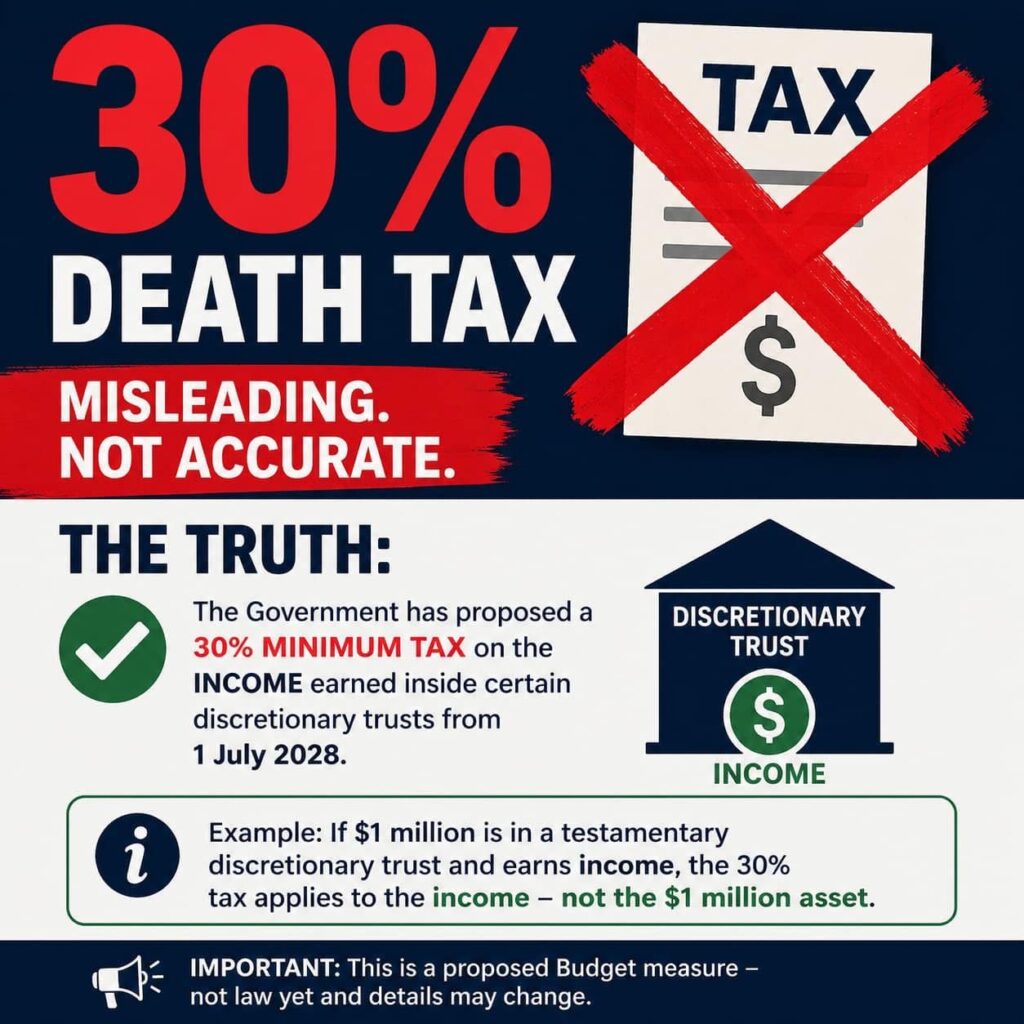
There has been a wave of alarming commentary online following the recent Federal Budget announcements, with some claiming Australia is introducing a “30% death tax” on inheritances and family wealth.
That is not what has been proposed.
As with many tax announcements, the reality is more nuanced than the headlines — and unfortunately some commentary has created unnecessary fear and confusion for families already dealing with complex estate planning decisions.
Let’s look at what has actually been announced.
What Has Been Proposed?
The Federal Budget included a proposed measure introducing a 30% minimum tax on the taxable income of discretionary trusts from 1 July 2028. Importantly:
- this is not a 30% tax on inherited assets themselves
- it is not a tax on the capital value of a deceased estate
- and it is not a broad-based inheritance tax.
The proposal relates to the income generated within certain discretionary trusts. For example, if a person leaves $1 million into a testamentary discretionary trust and that trust earns $50,000 of taxable income in a year, the proposed rules may impose a minimum 30% tax on that $50,000 income.
It is not a $300,000 tax on the original $1 million inheritance. That distinction matters.
Why Are People Calling It a “Death Tax”?
Much of the concern stems from the possible application of the proposal to some future testamentary discretionary trusts.
A testamentary trust is a trust created under a Will after someone passes away. These structures are commonly used in estate planning for:
- asset protection
- tax flexibility
- protecting vulnerable beneficiaries
- blended family planning
- and intergenerational wealth management.
Some commentators have suggested the proposal could affect future testamentary discretionary trusts established after the commencement date. That possibility has led to headlines implying the Government is taxing inheritances.
But again, the proposal is about future income generated within certain trust structures, not taxing the inherited assets themselves.
What Appears To Be Excluded?
Current Budget commentary and professional analysis suggest several structures are intended to remain excluded, including:
- deceased estates
- fixed trusts
- fixed testamentary trusts
- charitable trusts
- special disability trusts
- and complying superannuation funds.
There are also strong indications that existing testamentary trust arrangements may be grandfathered. However, and this is important…
This Is Not Yet Law
At this stage, the proposal remains an announced Budget measure only. The final legislation has not yet been released, and the detail will matter enormously. Key questions still to be clarified include:
- how future testamentary discretionary trusts will be treated
- the exact scope of any exclusions
- grandfathering rules
- interaction with existing trust taxation rules
- and whether the proposal changes during consultation.
In other words, there is still a long way to go before anyone should be making drastic estate planning decisions based on social media posts or sensational headlines.
Is It Still Worth Having a Testamentary Trust?
In many cases, yes. While the proposed changes may reduce some future tax advantages for certain discretionary testamentary trusts, tax is only one reason these structures exist. A properly drafted testamentary trust can still provide valuable benefits including:
Asset Protection: assets held within a testamentary trust may offer greater protection from:
- family law disputes
- bankruptcy
- creditor claims
- and relationship breakdowns involving beneficiaries.
For many families, this protection remains one of the biggest advantages.
Flexibility For Families: Testamentary trusts can provide flexibility in how income and capital are distributed over time. This can be particularly useful for:
- blended families
- beneficiaries with different financial needs
- children and grandchildren
- or beneficiaries who may need additional financial guidance.
Tax Planning Opportunities Still Exist
Even if a 30% minimum tax regime ultimately applies to some future discretionary testamentary trusts, that does not automatically make them ineffective. Depending on the final legislation, there may still be:
- tax planning flexibility
- access to concessional treatment for minors
- capital gains planning opportunities
- and strategic structuring benefits.
The final drafting will determine how significant any changes really are in practice.
Estate Control And Long-Term Planning
Many people use testamentary trusts not simply to minimise tax, but to:
- preserve family wealth
- protect vulnerable beneficiaries
- encourage responsible financial management
- and create long-term estate planning outcomes.
Those objectives do not disappear because of one proposed tax measure.
A Calm And Practical Approach
Estate planning is already emotional enough without unnecessary fear campaigns. For most Australians, the right response right now is not panic — it is simply:
- stay informed
- review your estate planning structures periodically
- and seek advice before making changes.
Well-structured testamentary trusts continue to provide significant benefits in many family situations, including asset protection and long-term estate flexibility. As always, good advice should be based on legislation and facts — not clickbait.
Final Thoughts
The current proposal does not amount to a 30% tax on inherited wealth or assets. It is a proposed minimum tax on income generated within certain discretionary trust structures, and the final legislation will determine exactly how far the rules extend.
For many families, testamentary trusts are still likely to remain a very valuable estate planning tool — even if some taxation outcomes change in the future.
We will continue monitoring the consultation process closely and provide updates as more detail becomes available. If you would like to review your estate planning or trust structures, feel free to contact the team at Freedom Financial Solutions.