The 2026 Federal Budget has introduced some of the biggest proposed changes to property investment and family trust taxation Australia has seen in decades.
While many of the measures are still only proposals and detailed legislation has not yet been released, the direction is becoming increasingly clear. The Government appears focused on discouraging speculative property investment, redirecting investors toward new housing supply, reducing tax advantages linked to property ownership, and tightening the use of discretionary family trusts.
For existing investors and business owners, the implications over the coming years could be significant.
1. Cost Of Living Relief – Or Lack Of It
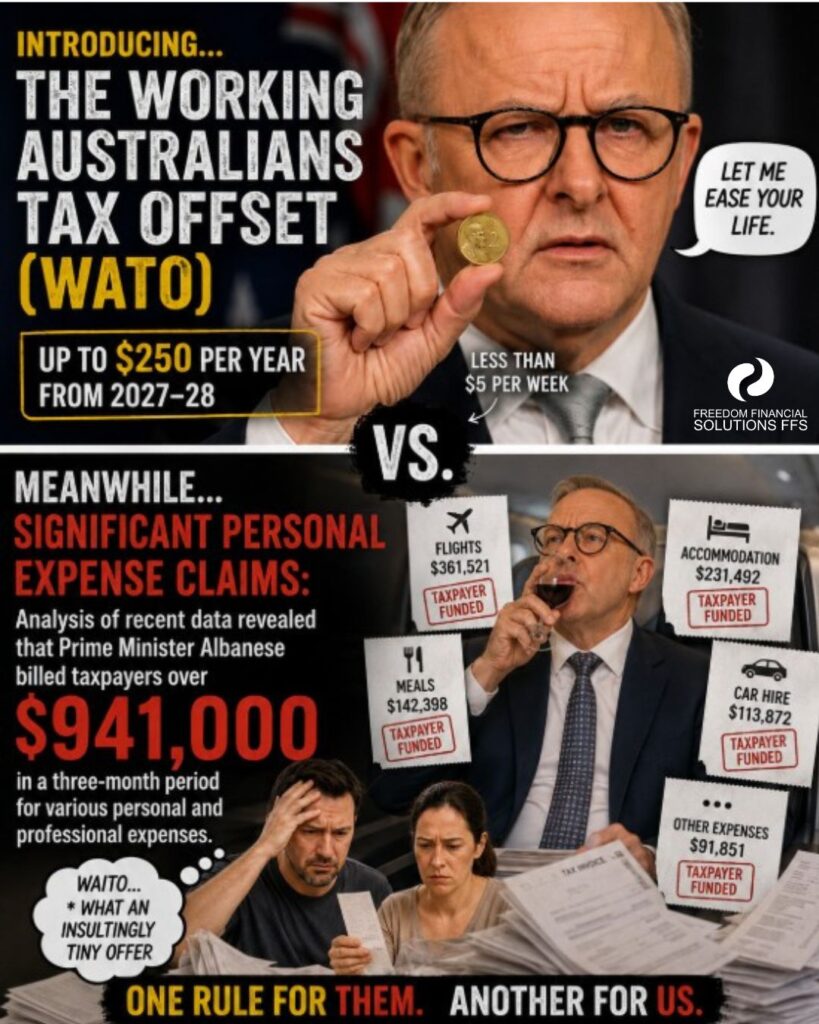
At a time when many Australians are already struggling with rising mortgage repayments, rent increases, higher food costs, insurance premiums, electricity prices and fuel costs, the Budget’s headline personal relief measure was a $250 annual tax offset.
Many Australians are already jokingly referring to the measure as “WAITO” — What An Insultingly Tiny Offer.
Realistically, $250 per year equates to less than $5 per week, or around 68 cents per day. In today’s economy, that level of support will barely touch the sides for most households.
In fact, $250 would roughly buy the average Australian about five decent steaks over an entire year.
For many families who have faced thousands of dollars in additional living costs over recent years, the Budget has left people feeling as though they are still waiting for genuine cost-of-living relief.
2. Negative Gearing Changes – A Major Structural Shift
One of the biggest announcements is the proposal to largely restrict negative gearing to newly built properties only from 1 July 2027.
Importantly, existing investment properties are expected to be grandfathered, meaning current owners should largely retain existing benefits. As a result, the major impact is likely to fall on future investment decisions rather than existing holdings.
Why This Is Much Bigger Than The “2 Property Cap”
Before the Budget, there had been speculation about limiting negative gearing to just two investment properties per person. However, this would actually have affected very few Australians.
ATO statistics show that approximately 71% of investors own only one property, while around 19% own two. In other words, about 90% of investors would have remained unaffected.
Instead, the Government has opted for a much broader reform by changing where investors can buy.
The message now appears to be: “Tax benefits will only apply if you help create new housing supply.”
3. Why Restricting Investors To New Builds May Not Work As Intended
While the Government hopes these changes will increase housing supply, there are several practical concerns.
Historically, when incentives are introduced for new builds only, developers and builders often increase prices, meaning much of the tax advantage is absorbed into higher purchase prices anyway.
In many areas, new properties are already significantly more expensive than established homes. They also often have smaller land components, lower yields and weaker long-term capital growth potential.
As a result, many investors may simply decide the numbers no longer stack up, the risks outweigh the rewards, and property investment is no longer as attractive as it once was.
4. Banks May Also Reduce Borrowing Capacity
Another hidden impact is likely to be on lending.
Currently, banks often factor negative gearing tax benefits into serviceability calculations and borrowing capacity assessments.
If deductions become more limited, borrowing power may fall, investors may qualify for smaller loans, and many Australians could find it harder to enter or expand within the property market.
So even investors who still want to buy may ultimately find it more difficult to do so.
5. Capital Gains Tax (CGT) Changes
The Budget also proposes major changes to the CGT system.
Again, existing properties are expected to be grandfathered, meaning current investors are unlikely to face immediate changes. However, the larger impact will likely be felt by future investors.
A Return To The Old Indexation System
Before 21 September 1999, Australia used an “indexation” method for capital gains tax, where the purchase cost of an asset was adjusted for inflation and investors paid tax only on the “real gain” after inflation.
In 1999, the Howard Government replaced this with the current 50% CGT discount for assets held longer than 12 months.
The new proposal appears to partially move back toward the older indexation-style approach.
What This Means
Combined with the negative gearing changes, property investment may become significantly less attractive. Investors may begin focusing more heavily on cash flow rather than capital growth, while speculative investment activity could reduce over time.
This may eventually place downward pressure on investor demand, price growth and some property market values — which, in many ways, appears to be exactly what the Government is attempting to achieve in order to improve housing affordability.
6. Proposed 30% Tax On Family Trusts
Another major announcement is the proposal for a 30% minimum tax on discretionary trust distributions from 1 July 2028.
At this stage, detailed legislation has not yet been released and many technical questions remain unanswered. However, the proposal appears designed to ensure trust income ultimately faces at least a 30% effective tax rate.
7. Why This Matters To Small Business
Importantly, this is not simply a “wealthy investor” issue.
Family businesses make up approximately 70% of Australian businesses, and Australia also has more than 840,000 discretionary trusts.
A very large number of small businesses, farms, professional practices and family enterprises operate through these structures for legitimate reasons, including asset protection, succession planning, flexibility and family ownership arrangements.
8. Example – How The Trust Tax Changes Could Work
Example Family Business
Assume a business generates profits of $400,000 which are distributed equally to Mum, Dad and two adult children working in the business.
Each individual receives $100,000.
Under current tax rules, approximate tax per person would be around $22,800 plus Medicare, resulting in combined family tax of approximately $91,000, or an effective tax rate of around 22.8%.
Under the proposed 30% minimum trust tax, however, the same $400,000 could face total tax of approximately $120,000 — an increase of roughly $29,000 per year.
Importantly, this example involves a genuine working family business, not passive beneficiaries or artificial tax arrangements.
9. Impact On Family Protection Trust Structures
Importantly, based on the information released so far, these proposed changes do not appear to fundamentally undermine the long-term Family Protection Trust structures we have been recommending.
The primary purpose of these structures has always been long-term asset protection, intergenerational wealth preservation, succession planning and protecting family assets from personal risk — not simply short-term tax minimisation.
At this stage, the proposed 30% tax appears more likely to apply to taxable trust distributions rather than the ownership of the underlying assets themselves.
This means the greatest impact may arise where trust assets are generating positive taxable income, such as positively geared investment properties or businesses generating surplus profits, rather than affecting the long-term holding structure itself.
Of course, until full legislation is released, many details remain unknown.
10. The Bigger Picture – What Could This Mean For Property Values?
Taken together, these reforms may significantly reduce investor appetite for residential property over time.
The combined effect of reduced negative gearing access, weaker CGT concessions, reduced borrowing capacity and higher trust taxation could dramatically reshape the investment landscape.
While this may improve affordability for younger Australians and future generations, it could also reduce investor demand, slow future property price growth, reshape retirement planning strategies and affect the long-term value of existing property portfolios.
For many Australians, residential property has formed a core part of wealth creation and retirement planning for decades.
This Budget may represent the beginning of a very different property investment environment moving forward.